
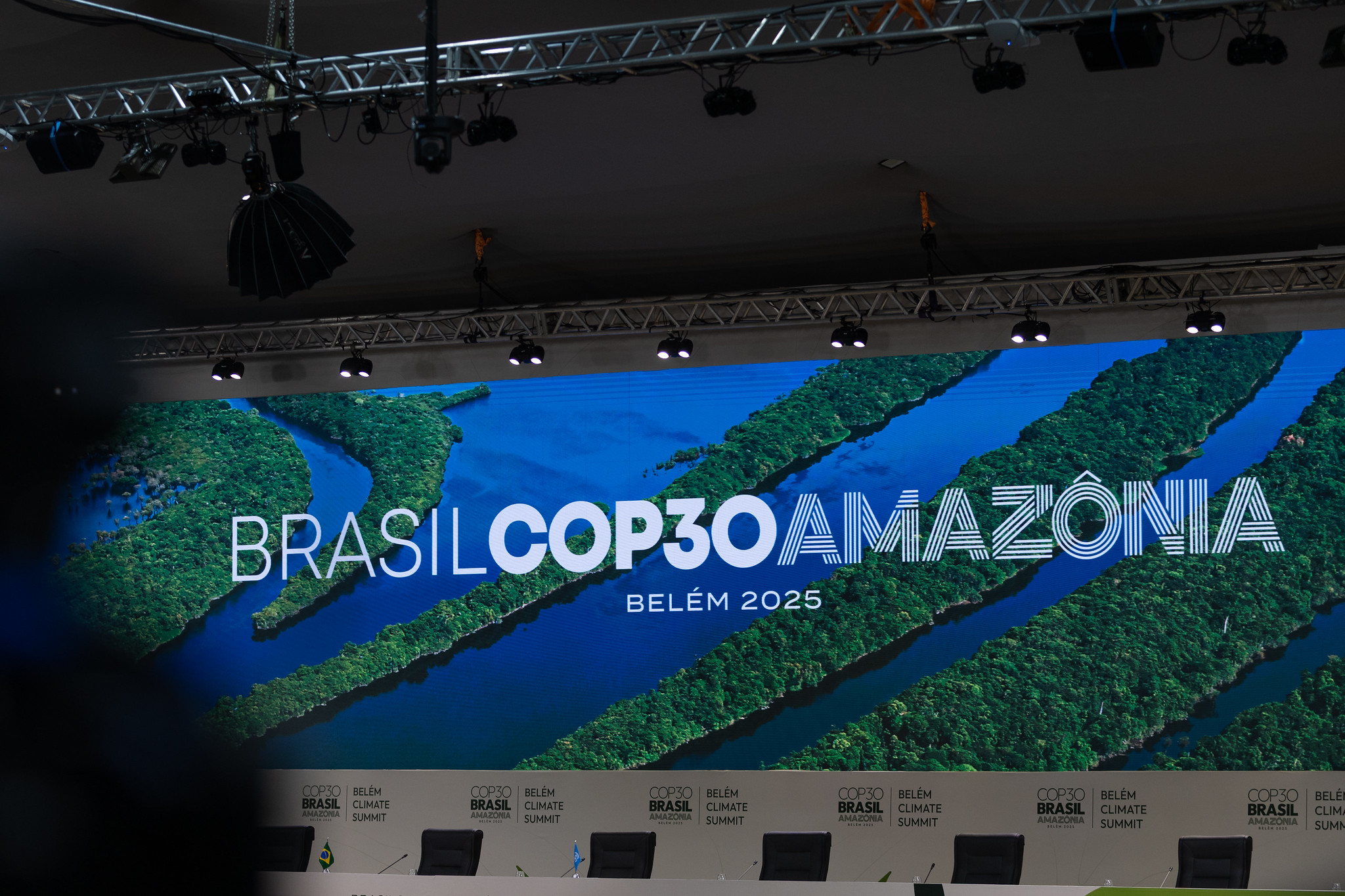
Featured image: “Belém Climate Summit Opening Plenary” by UNclimatechange
Summary
COP30 showcased both significant progress and critical gaps in global climate action. Civil society exerted strong pressure to accelerate efforts against climate change and protect vulnerable communities, underscored by demands for more accessible and impactful climate finance. However, the summit failed to secure a strong commitment to phasing out fossil fuels and did not provide a clear, actionable roadmap to address the escalating deforestation crisis. These developments highlight both the ongoing challenges and the need for intensified global cooperation to achieve long-term climate goals.
What happened at COP30?
The 30th United Nations Climate Change Conference (COP30), held in Belém, Brazil, from 10–21 November 2025, brought together world leaders, negotiators, and civil society to advance global climate action. Hosted in the heart of the Amazon rainforest, the summit carried heightened urgency for addressing climate change. Yet, despite high hopes, the conference remained marked by polarising debates and contentious negotiations on key issues such as fossil fuel transition, deforestation, and climate finance.
Although the conference did not deliver binding commitments, it underscored the importance of collective action and community-driven initiatives. A key outcome was the launch of the Global Mutirão initiative — based on a Tupi-Guarani term meaning “collective effort” — aimed at mobilising communities, cities, and individuals worldwide. This initiative forms a central part of the agreement endorsed by 194 countries, including Ukraine, helping maintain momentum moving forward.
In his closing speech, Simon Stiell, Executive Secretary of the UN Framework Convention on Climate Change (UNFCCC), acknowledged the turbulent political backdrop in which COP30 unfolded. “We knew this COP would take place in stormy political waters. Denial, division, and geopolitics have dealt international cooperation some heavy blows this year,” he said. “But friends, COP30 showed that climate cooperation is alive and kicking, keeping humanity in the fight for a livable planet, with a firm resolve to keep 1.5°C within reach. I’m not saying we’re winning the climate fight. But we are undeniably still in it, and we are fighting back. Here in Belém, nations chose solidarity, science, and economic common sense.”
While Stiell’s remarks conveyed determination, they also underscored the deep challenges that continue to stall progress on critical climate issues.
Key Takeaways
Fossil fuel transition and lack of agreement
One of the most anticipated outcomes of COP30 was a global commitment to a clear and actionable roadmap for phasing out fossil fuels. Unfortunately, the summit fell short, with countries heavily reliant on oil production, notably Saudi Arabia, Russia, and their allies, playing a critical role in blocking an accelerated phase-out. Despite pressure from climate advocates, no binding commitments were reached, and while some plans for a transition to renewable energy were outlined, the lack of a concrete timeline left many disappointed. All explicit references to fossil fuels were removed from the final text, leaving only a vague mention of the “UAE Consensus” from COP28, offering no clear roadmap, targets, or timelines.
In response, COP President André Corrêa do Lago announced that Brazil would take the lead in developing two fossil fuel phase-out roadmaps outside the formal UN COP negotiation process. He revealed that a “First International Conference for the Phase-out of Fossil Fuels” is scheduled to be held in Colombia in April 2026.
The fight against deforestation
Given that COP30 was hosted in Brazil, near the heart of the Amazon rainforest, deforestation was expected to be a central issue. Global expectations were high, especially after more than 100 countries pledged at COP26 to halt and reverse deforestation by 2030. Yet the summit ended without a clear roadmap to fulfil this commitment, despite widespread recognition of the critical role that tropical and global forests play in stabilising the climate.
As Dr Aline Soterroni, a Brazilian scientist working on climate–nature linkages at the Department of Biology, remarked:
“It is disappointing to see a ‘forest COP’ in the Amazon advance without strong language on halting and reversing deforestation and forest degradation by 2030.”
Nonetheless, COP30 did make some progress on forest funding, with over USD 5.5 billion announced for the Tropical Forests Forever Facility (TFFF). The initiative aims to mobilise resources to protect rainforests and support sustainable land-use practices. While these financial pledges fall short of binding deforestation commitments, they represent important steps forward in forest conservation and climate resilience.
Climate Finance: Baku to Belém roadmap and tripling adaptation finance
Although not formally on the agenda, climate finance was a central focus at COP30, with discussions concentrating on how countries will deliver the New Collective Quantified Goal (NCQG) adopted in Baku, including scaling up public finance under Article 9.1 of the Paris Agreement. The Mutirão decision established a two-year work programme to maintain momentum on implementing the Baku commitments, providing a platform for follow-up through the Baku to Belém Roadmap. This roadmap aims to mobilise USD 1.3 trillion annually by 2035 from both public and private sources, while also supporting developing countries in pushing for the USD 300 billion public-finance target, essential for climate action in the coming decade.
Building on these broader climate finance commitments, COP30 also delivered a headline outcome: an agreement to triple global adaptation finance by 2035. In concrete terms, this effectively sets a new target of roughly US$120 billion per year for adaptation, up from about US$40 billion under previous global finance goals. That said, the agreement fell short of many expectations. Critics argue the timeline — 2035 — is too delayed, given that climate‑vulnerable countries are already suffering from severe impacts of climate change. As measured commitments remain vague, some organisations emphasised the risk this poses to vulnerable populations.
Gender action plan agreed
The Belém negotiations concluded with the adoption of the long-awaited Gender Action Plan. The outcome strengthens gender-responsive climate action by promoting the use of disaggregated data, gender analysis, and improved coordination among key actors. It also calls for countries to integrate gender considerations into national climate policies and UNFCCC reporting, helping to ensure clearer accountability across all areas of climate action. Importantly, the plan recognises that factors such as race, disability, and age shape how people experience climate impacts and engage in solutions. Strengthening the evidence base on these intersecting issues will be essential as countries implement the plan over the coming decade.
Trade barriers and the just transition mechanism
COP30 featured debates on trade measures linked to climate action, including the European Union’s Carbon Border Adjustment Mechanism (CBAM). Many countries, especially China, India, and Saudi Arabia, expressed concerns about what they called “unilateral trade agreements,” noting that such measures could have adverse effects on Global South countries. In the end, a decision included an agreement to review trade issues through three annual dialogues, beginning next June.
Many were pleased that the agreement included a “just transition mechanism”, designed to support workers and communities affected by the shift away from fossil fuels. It provides policies and financial resources to retrain workers, create green jobs, and foster sustainable economic opportunities in regions traditionally reliant on fossil fuel industries.
Progress on NDCs
By the end of COP30, 119 countries representing 74% of global emissions had submitted updated NDCs, showing some progress on emissions reduction and sectoral action but still falling far short of the cuts needed by 2035 to keep warming within 1.5 °C. In response, COP30 launched two voluntary initiatives — the Global Implementation Accelerator and the “Belém Mission to 1.5”— to accelerate NDC and national adaptation plan implementation. For the first time, negotiators acknowledged the risk of overshooting 1.5 °C and the importance of limiting both its magnitude and duration, with progress from these initiatives set to be reviewed at COP31 in 2026.
The role of civil society and demonstrations
Civil society had a strong presence at COP30, notably with the 70,000-strong climate justice march in Belém. Activists, youth groups, and environmentalists pushed for stronger climate commitments, urging world leaders to act decisively. The parallel People’s Summit brought together Indigenous groups, environmental justice campaigners, and community leaders, emphasising that the most vulnerable communities must be central to climate action. Indigenous protesters, particularly from the Amazon, stressed the need to protect their lands and traditional ways of life from deforestation and industrialisation. While COP30 offered a platform for these voices, some critics contend that grassroots concerns were not fully prioritised in the official negotiations.
Looking ahead: COP31 and the path forward
Looking ahead, COP31 in 2026, which will take place in Turkey, will be a crucial opportunity to build on the momentum of the Baku to Belém roadmap and the Global Mutirão initiative. The focus now shifts to turning these frameworks into concrete policies with clear timelines, particularly as climate impacts become increasingly urgent for vulnerable regions. Bold leadership and continued pressure from civil society will be essential to ensure that the commitments made at COP30 are followed through with meaningful action.
COP30 has shown that while the road ahead is challenging, there is still room for hope. The decisions made in Belém will be pivotal in determining whether global efforts can be scaled up to meet the ever-growing climate demands. Now, the focus is on ensuring that the spirit of solidarity and cooperation demonstrated at this summit is translated into meaningful, long-term change.