Skip to content

Sustainability in business refers to the integration of environmental, social, and governance practices into core business operations, strategy, and decision-making, with the objective of managing long-term risk, reducing operational cost, and maintaining licence to operate across markets. For most organisations, the question has shifted from whether to act on sustainability to which actions generate the most measurable return. The evidence in 2026 is clear: the businesses executing sustainable business practices most effectively are not doing so primarily for reputational reasons. They are doing so because the financial case is no longer ambiguous.
Why sustainability in business has become a risk management imperative
The regulatory landscape has fundamentally changed the cost of inaction. The EU’s Corporate Sustainability Reporting Directive came into force for large undertakings in 2024 and extends to listed SMEs by 2026. The Corporate Sustainability Due Diligence Directive introduces legal liability for environmental and human rights failures across supply chains. The EU Carbon Border Adjustment Mechanism is applying a carbon price to imports in energy-intensive sectors including steel, cement, aluminium, and chemicals.
For businesses operating across European markets, non-compliance with these frameworks carries financial penalties, restricted access to public procurement, and increasing difficulty accessing institutional capital. According to a 2025 report by Deloitte, 61% of institutional investors now apply ESG screens to investment decisions, and 43% have divested from holdings that failed to meet minimum sustainability disclosure standards.
The risk is not only regulatory. Physical climate risk is repricing assets and insurance in exposed sectors. Swiss Re estimates that uninsured climate-related losses reached $280 billion globally in 2024. For real estate, agriculture, logistics, and infrastructure businesses, the cost of ignoring physical risk is increasingly appearing on the balance sheet.
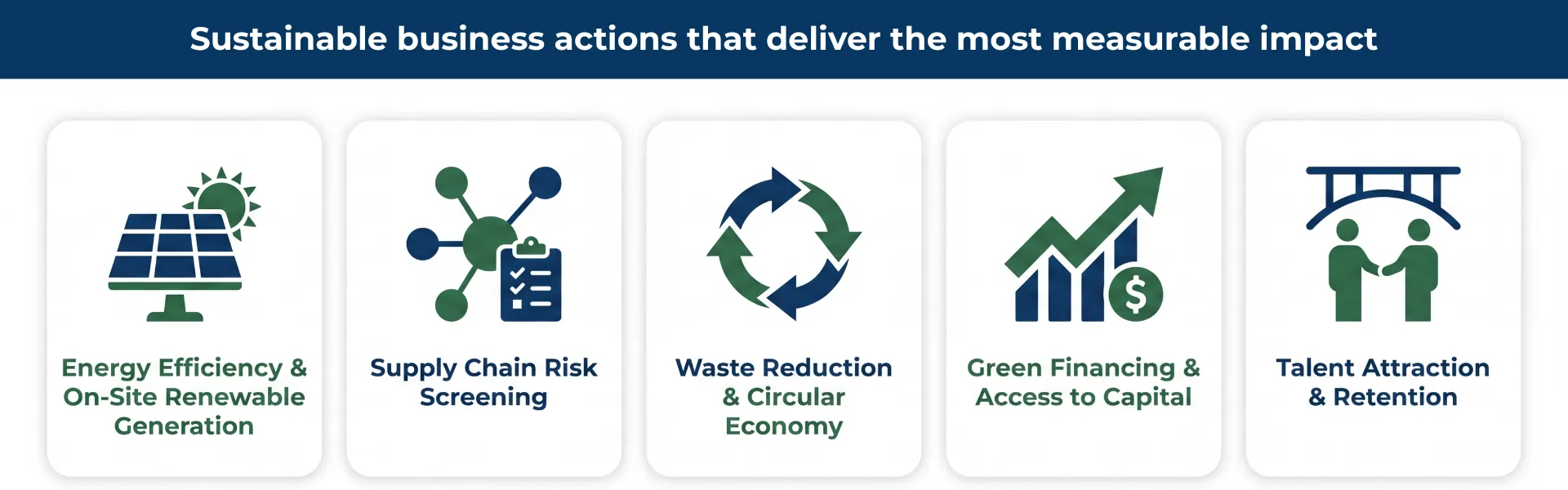
Business actions that deliver the most measurable impact
Energy efficiency and on-site renewable generation
Energy cost is one of the most direct levers available to businesses pursuing sustainability in business. For manufacturing, logistics, retail, and hospitality operators, energy typically represents 10 to 30% of total operating costs. Implementing smart energy management systems, upgrading to LED lighting with IoT controls, and deploying on-site solar PV consistently reduces energy expenditure by 20 to 40% depending on the baseline.
The return on investment is well-documented. The Carbon Trust estimates that a 20% reduction in energy costs delivers the same bottom-line impact as a 5% increase in sales for a typical manufacturer. For businesses with multiple sites, centralised energy monitoring platforms provide the granular data needed to identify the highest-consumption facilities and prioritise capital allocation accordingly.
Supply chain risk reduction through sustainability screening
Supply chain disruption has become one of the most significant sources of operational and reputational risk for businesses across sectors. The EU Corporate Sustainability Due Diligence Directive places legal responsibility on large companies for environmental and labour violations within their supply chains. Beyond compliance, supplier failures linked to environmental non-compliance, water scarcity, or labour disputes are generating tangible operational losses.
Sustainable business practices in procurement involve mapping Tier 1 and Tier 2 suppliers against ESG performance criteria, water stress exposure, country-level regulatory risk, and deforestation risk. Businesses that have implemented supplier sustainability scoring consistently report earlier identification of concentration risk and more resilient sourcing strategies. According to McKinsey’s 2025 supply chain survey, companies with mature supplier sustainability programmes experienced 15% fewer supply disruptions than peers without them.
Waste reduction and circular economy practices
Waste represents cost. Every kilogram of material that enters a production process and exits as waste carries the embedded cost of procurement, handling, and disposal. Sustainability in business frameworks that apply circular economy principles to production design, packaging, and logistics consistently identify cost reduction opportunities that conventional operational reviews miss.
Unilever reported cumulative savings of over €1.5 billion between 2008 and 2024 through waste reduction and resource efficiency programmes across its manufacturing network. For mid-sized businesses, the scale is smaller, but the proportional impact is equivalent. A structured waste audit combined with supplier take-back programmes and packaging redesign typically delivers payback within 12 to 24 months.
Green financing and access to capital
Businesses with credible sustainability credentials and verified ESG reporting access capital on materially better terms than those without. The green bond market reached $620 billion in issuance in 2024, according to the Climate Bonds Initiative. Sustainability-linked loans, which tie interest rates to the achievement of ESG performance targets, are now mainstream products across European corporate banking.
For capital-intensive businesses in energy, real estate, and infrastructure, the differential between conventional debt and green financing instruments is significant. Businesses that invest in the reporting infrastructure and governance frameworks needed to qualify for sustainability-linked instruments are generating direct financial return from their sustainable business practices in addition to operational savings.
Talent attraction and retention
The link between sustainability in business and workforce performance is supported by consistent data. A 2025 IBM Institute for Business Value survey found that 67% of employees and job seekers consider a company’s sustainability credentials when choosing an employer, with the figure rising to 74% among candidates under 35. In sectors facing acute talent shortages, including technology, energy, and professional services, sustainability positioning is a material competitive advantage in recruitment.
Retention data reinforces the same point. Businesses with strong sustainability cultures and credible ESG commitments report lower voluntary turnover rates, reduced recruitment costs, and higher employee engagement scores than sector averages. For businesses where talent acquisition and retention represent a significant cost line, the ROI on sustainability investment extends well beyond operational savings.
A practical example: what integrated sustainability action looks like
A mid-sized European logistics operator with 12 distribution centres implements a structured sustainability in business programme across four workstreams: energy efficiency, fleet electrification, supplier sustainability screening, and CSRD-aligned reporting.
Year one outcomes include a 28% reduction in energy costs across the estate through smart metering and LED retrofits, qualification for a sustainability-linked revolving credit facility at 40 basis points below the conventional rate, identification of two high-risk suppliers with water stress exposure in their operating regions, and a CSRD-compliant sustainability report that satisfies three major client procurement requirements without separate questionnaire completion.
The programme pays for itself in year one through energy savings and financing differential alone. By year three, the sustainability function has become a direct contributor to client retention and new business development.
EnableGreen view and analysis
By Hayatte Loukili, Executive Search Director and Energy Transition Market Expert, EnableGreen
The businesses that treat sustainability in business as a cost centre are misreading the market. The ones treating it as a risk management and value creation function are consistently outperforming peers on cost efficiency, access to capital, and talent retention.
What we observe in the organisations we work with is that the execution gap is rarely a strategy problem. Most leadership teams understand the case for sustainable business practices. The gap is in capability. Building a sustainability function that connects environmental and social performance data to operational and financial decision-making requires professionals with a genuinely cross-functional skill set: regulatory knowledge, financial modelling, data management, and the commercial credibility to influence investment decisions.
“The businesses that will define best practice in sustainability over the next five years are not those with the most ambitious targets. They are those with the operational discipline to execute against them. That requires the right team as much as the right strategy. Hiring a sustainability manager who can write a CSRD report is not the same as hiring one who can identify a €500,000 energy-saving opportunity and build the business case to fund it. The market is beginning to understand that distinction.”
At EnableGreen, we place sustainability professionals across the full value chain, from ESG reporting and data management to energy management, supply chain sustainability, and sustainable finance. If you are building or scaling a sustainability function, explore our current opportunities or contact us directly.
FAQ
What does sustainability in business mean in practice?
Sustainability in business means integrating environmental, social, and governance considerations into core business operations, procurement, finance, and strategy. In practice, it covers energy efficiency, supply chain risk management, waste reduction, ESG reporting, green financing, and workforce practices, each of which carries measurable financial and operational implications.
Which sustainable business practices deliver the fastest financial return?
Energy efficiency upgrades and on-site renewable generation consistently deliver the shortest payback periods, typically one to four years. Waste reduction programmes and green financing instruments follow closely. Supply chain sustainability screening delivers returns over a longer horizon while reducing the frequency and cost of supply disruptions.
How does sustainability in business reduce regulatory risk?
CSRD, the EU Corporate Sustainability Due Diligence Directive, and the Carbon Border Adjustment Mechanism all create direct financial liability for businesses that fail to meet sustainability disclosure and performance standards. Proactive implementation of sustainable business practices reduces exposure to penalties, restricted procurement access, and divestment by institutional investors.
What skills does a business need to execute a sustainability programme effectively?
Effective execution requires professionals who combine regulatory knowledge, ESG data management, financial modelling, and operational credibility. The most effective sustainability functions are staffed by people who can translate environmental and social performance data into business decisions, not only compliance reports. For support building this capability, visit EnableGreen.
Sources and references
- Deloitte, Global ESG Investor Survey 2025: https://www.deloitte.com
- Swiss Re Institute, Natural Catastrophe Report 2024: https://www.swissre.com
- Carbon Trust, Energy Efficiency and Business Competitiveness: https://www.carbontrust.com
- McKinsey, Supply Chain Sustainability Survey 2025: https://www.mckinsey.com
- Climate Bonds Initiative, Green Bond Market Report 2024: https://www.climatebonds.net
- IBM Institute for Business Value, Sustainability and Workforce 2025: https://www.ibm.com/thought-leadership/institute-business-value
- Unilever, Sustainable Living Plan Progress Report: https://www.unilever.com/sustainability
- European Commission, CSRD Implementation: https://finance.ec.europa.eu
- European Commission, CS3D Directive: https://commission.europa.eu
- EnableGreen, ESG recruitment and sustainability roles: https://enable.green/esg-recruitment