
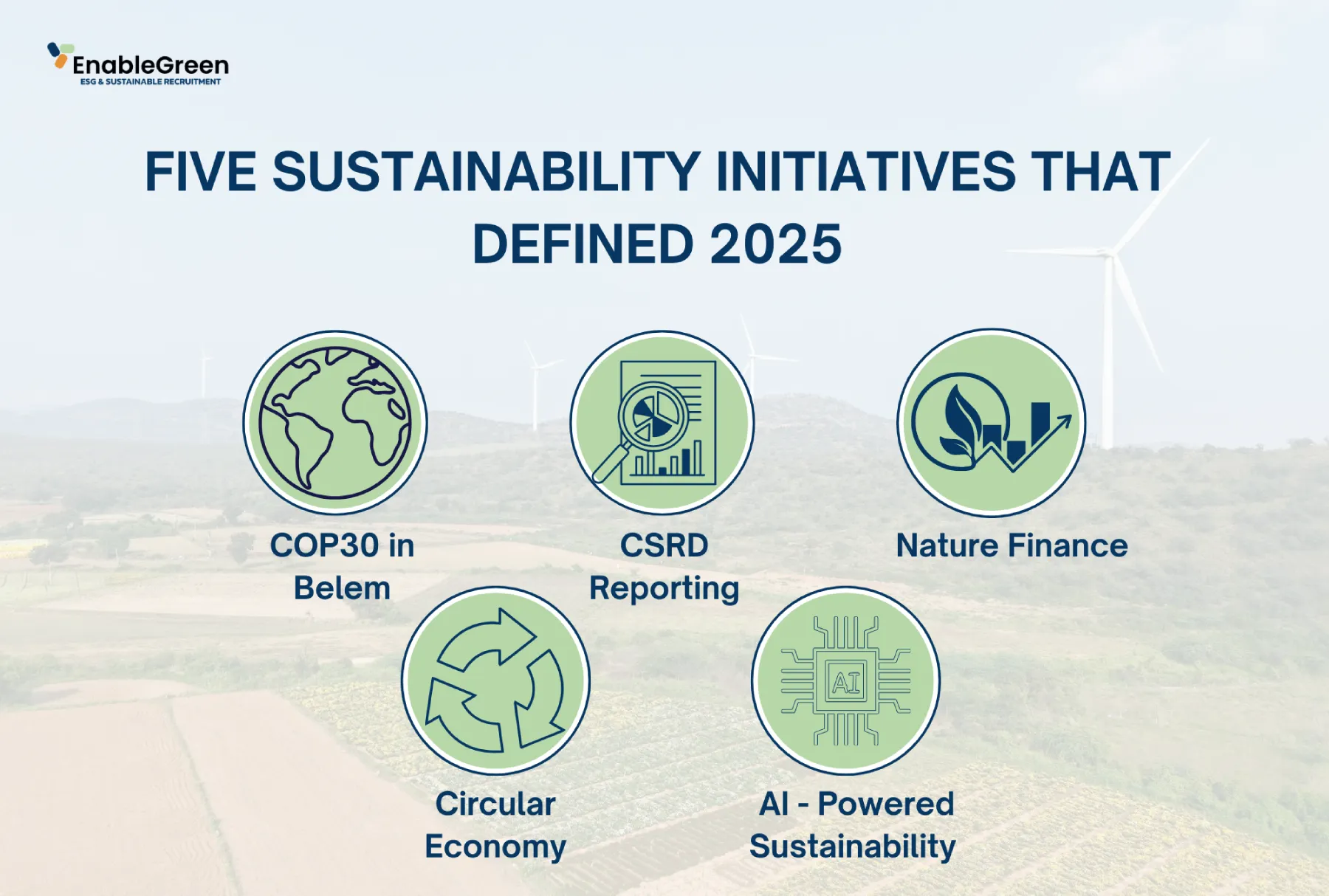

2025 will be remembered as the year sustainability moved from strategic intent to operational reality. Across policy, finance, corporate governance, and global diplomacy, the sustainability initiatives that emerged or reached maturity this year did not simply set targets, they established frameworks, unlocked capital, and demanded accountability in ways that previous declarations rarely achieved.
For business leaders, asset owners, and sustainability professionals, the events of 2025 carry specific lessons. The gap between organisations that treat sustainability as a reporting exercise and those that embed it as a performance discipline is widening. Understanding which sustainability initiatives defined the year and why they matter is the starting point for any organisation serious about being on the right side of that divide.
Why 2025 was a turning point for sustainability initiatives
Several forces converged in 2025 to create conditions for genuine acceleration. Renewable energy investment globally overtook fossil fuel investment by a ratio of two to one, according to COP30 reporting ; a market signal with structural implications for every sector. Mandatory sustainability reporting entered force in Europe, raising the standard of evidence companies must produce. And the geopolitical framing of sustainability shifted decisively: from burden to competitive advantage.
The Morgan Stanley Institute for Sustainable Investing surveyed sustainability decision-makers across 300 companies globally in 2025 and found that 88% considered sustainability primarily or partly a value creation opportunity, up from prior years. More than half reported direct operational impact from climate-related events, with 80% committing to increased resilience measures. The business case for sustainability initiatives, in other words, has crossed from theoretical to empirical.
Against this backdrop, five sustainability initiatives stand out for their scale, structural significance, and the quality of the lessons they generate for practitioners.
The 5 sustainability initiatives that defined 2025
1. COP30 in Belém: The Belém package and the $1.3 trillion climate finance commitment
Held in Belém, Brazil on the edge of the Amazon basin, COP30 was one of the most symbolically charged climate conferences in the history of the Paris Agreement. The choice of location was deliberate: Brazil, home to 60% of the Amazon rainforest, placed biodiversity and forest ecosystems at the centre of climate diplomacy for the first time with this level of visibility.
The headline outcome was the adoption of the 29-point Belém Package by 195 countries. This included a commitment to mobilise $1.3 trillion annually by 2035 for climate action, a pledge to triple adaptation finance by 2035, and the operationalisation of the Loss and Damage Fund. New mechanisms launched under the Action Agenda included the Belém Mission to 1.5°C, the Global Implementation Accelerator, and the Tropical Forests Forever Fund, which raised $5.5 billion across 53 participating countries with at least 20% of resources directed to Indigenous Peoples and local communities.
The UNEZA Alliance, comprising public utility companies, pledged $66 billion annually for renewable energy and $82 billion for transmission and storage. A coalition spanning 25,000 buildings reported cutting over 850,000 tonnes of CO₂ in the preceding year. The Belém Health Action Plan — the first global initiative targeting climate-related health threats launched with $300 million from 35 philanthropic organisations.
| Note | COP30 did not include an explicit commitment to phasing out fossil fuels which is a notable gap relative to COP28. This tension between market momentum (renewables investment at 2:1 over fossil fuels) and the absence of formal policy mandates is the defining challenge for climate governance entering 2026. |
Why it matters: COP30 demonstrated that the financial architecture for climate action is now being constructed at scale. The $1.3 trillion annual target, while non-binding in its current form, sets a reference point against which private finance, development banks, and sovereign commitments will be measured for the next decade.
Lessons for organisations: Businesses operating in or supplying to markets covered by NDC 3.0 commitments which 122+ countries updated at COP30, face a materially different regulatory and investment landscape from 2026 onward. Transition planning aligned with these updated NDCs is no longer optional for organisations seeking access to sustainable finance instruments.
2. The CSRD goes live: Mandatory sustainability reporting reshapes corporate accountability
The Corporate Sustainability Reporting Directive represents one of the most consequential regulatory shifts in the history of European corporate governance. In 2025, it moved from legislative text to operational reality: companies previously subject to the Non-Financial Reporting Directive (NFRD) were required to publish their first CSRD-compliant reports, covering fiscal year 2024. From fiscal year 2025, the obligations expanded to all other large European companies and certain international groups.
The CSRD introduced requirements that fundamentally changed what sustainability reporting means. Companies must now conduct a double materiality assessment, analysing both their impact on sustainability issues and the financial risks those issues pose to the business. Reports must be prepared according to European Sustainability Reporting Standards (ESRS), published in machine-readable ESEF format, and subject to third-party limited assurance from 2025 — with the potential for reasonable assurance from 2028.
In February 2025, the European Commission proposed amendments to the CSRD as part of the Omnibus I simplification package, ultimately narrowing scope to companies with more than 1,000 employees and €450 million or more in annual turnover. The European Parliament approved this revised scope in December 2025. For many mid-sized companies, this created temporary regulatory relief — but did not remove the strategic imperative to build sustainability data infrastructure.
| Key figure | The CSRD in its revised form directly applies to the largest companies — but supply chain disclosure requirements mean that thousands of smaller organisations in those companies’ value chains face indirect pressure to report equivalent data. |
Why it matters: The CSRD is the most structurally significant sustainability reporting framework ever enacted. It transforms sustainability disclosures from a voluntary communications exercise into an audited, comparable, machine-readable body of evidence. The quality of this evidence directly influences access to green financing, investor confidence, and procurement eligibility.
Lessons for organisations: Audit-quality sustainability data is now a business infrastructure requirement, not a reporting afterthought. Organisations that built data collection systems in 2025 tracking scope 1, 2, and 3 emissions, biodiversity impacts, and social metrics will be structurally advantaged in financing, partnership selection, and regulatory navigation through the next decade.
3. Nature finance reaches critical mass: The tropical forests forever fund and biodiversity mainstreaming
For most of the last decade, biodiversity commitments remained largely disconnected from financial markets. 2025 changed that. The Tropical Forests Forever Fund, launched under the COP30 Action Agenda, raised $5.5 billion across 53 countries with an explicit allocation floor requiring at least 20% of resources to flow directly to Indigenous Peoples and local communities. This architecture represented a meaningful departure from traditional conservation finance, where delivery to local actors had historically been diluted through intermediary structures.
Simultaneously, reforestation, mangrove restoration, and regenerative agriculture received materially increased funding from governments and corporations across Asia Pacific, Latin America, and sub-Saharan Africa. These investments were increasingly tied to the Kunming-Montreal Global Biodiversity Framework, which set the global target of protecting 30% of land and oceans by 2030. Corporate nature-related disclosures under TNFD (Taskforce on Nature-related Financial Disclosures) expanded significantly, with voluntary reporting frameworks beginning to converge with mandatory requirements in several jurisdictions.
The World Economic Forum’s Global Risks Report ranked biodiversity loss as one of the top five threats facing humanity over the next decade. In 2025, that framing acquired financial substance: nature-positive strategies moved from the ESG appendix into core credit risk assessments, supplier qualification frameworks, and real estate valuation models.
| Best practice | Companies most advanced in biodiversity integration in 2025 were those that moved beyond carbon-only transition planning to conduct nature dependency mapping, identifying where their operations, supply chains, and financing rely on ecosystem services that are under measurable threat. |
Why it matters: Nature-related financial risk is on a trajectory toward mandatory disclosure in multiple jurisdictions. Organisations without a credible biodiversity baseline face increasing exposure in financing, insurance, and regulatory contexts over the next five years.
Lessons for organisations: Start with a nature dependency and impact assessment grounded in operational data. The organisations that moved first on carbon accounting in the early 2010s built structural advantages that compounded over time. The same dynamic is now forming around nature.
4. Circular economy at scale: From pilot projects to company-wide execution
2025 marked a decisive shift in the maturity of circular economy implementation across the industry. The frame changed from experimentation to execution. Industry leaders such as Siemens and Decathlon moved circular models from isolated pilot programmes to company-wide operational standards, demonstrating that alignment between profitability and environmental impact was achievable at portfolio scale, not just at the margins.
Across retail and logistics, product take-back programmes, refurbishment operations, and material recovery systems reached commercial viability at a pace that earlier projections had placed several years further out. IKEA’s global refurbishment programme expanded to additional markets, establishing a reference model for how large-format retailers could restructure product lifecycles without sacrificing margin. In manufacturing, McKinsey research documented leading multinational firms adopting integrated circular economy strategies across entire product portfolios — not as brand positioning, but as supply chain risk mitigation in response to materials scarcity and the EU’s incoming product-level sustainability requirements.
The regulatory environment accelerated the transition. The EU’s Green Claims Directive, already influencing marketing and labelling practices ahead of its expected entry into force in 2028, raised the evidentiary bar for product sustainability claims and specifically banned impact claims based solely on offset schemes. This forced a reckoning with lifecycle analysis, material composition, and repairability across consumer goods categories.
| Insight | The organisations scaling circular models most effectively in 2025 were not those with the most ambitious circularity targets, they were those that had redesigned procurement, logistics, and product development processes to make circularity the path of least resistance operationally. |
Why it matters: Circular economy models are increasingly the basis on which product market access in Europe is negotiated, through Extended Producer Responsibility frameworks, eco-design requirements, and procurement specifications that favour lifecycle performance over upfront price.
Lessons for organisations: Circularity requires system redesign, not product retrofit. The most durable competitive advantage in this space comes from redesigning procurement and design processes, not from attaching recycling messaging to products designed for a linear model.
5. AI-powered sustainability: Precision agriculture, supply chain decarbonisation, and intelligent infrastructure
The intersection of artificial intelligence and sustainability — often described as the twin transition, matured substantially in 2025. What distinguished this year from prior cycles of technology-sustainability optimism was specificity: AI applications moved from proof-of-concept to measurable, monetised operational performance in several critical domains.
In agriculture, AI-driven algorithms enabled precision farming at commercial scale. By analysing soil data, plant health indicators, and weather forecasts in real time, AI systems provided actionable guidance on irrigation, fertilisation, and pest management — reducing input waste, lowering emissions, and improving yield stability. The UN Climate Change Initiative on Artificial Intelligence for Climate Action cited precision agriculture as one of the most tractable near-term applications of AI for emissions reduction in the land sector.
In corporate supply chains, AI-powered emissions mapping tools enabled companies to identify and quantify scope 3 emissions with a precision previously achievable only through bespoke consulting engagements. This data quality improvement had direct implications for CSRD compliance, science-based target validation, and supplier engagement programmes. Energy management in commercial and industrial infrastructure also saw material gains: intelligent building management systems using machine learning to optimise HVAC, lighting, and power flows in real time consistently delivered energy reductions of 15–30% against baseline in validated deployments.
| Watch point | The energy consumption of large-scale AI infrastructure itself has emerged as a material sustainability concern. Organisations deploying AI for sustainability purposes face the parallel challenge of ensuring their AI infrastructure is powered by clean energy — a requirement that is increasingly explicit in science-based targets and EU Taxonomy alignment criteria. |
Why it matters: AI is compressing the timeline for sustainability performance improvement in agriculture, logistics, and infrastructure. Organisations that deploy AI for energy and resource optimisation in 2025 and 2026 will capture efficiency gains that those delaying implementation will take years to recover.
Lessons for organisations: The most effective AI sustainability deployments in 2025 shared a common characteristic: they were grounded in high-quality operational data collected over time, rather than applied to sparse or inconsistent datasets. Data infrastructure investment is the prerequisite for AI value in sustainability.
The Author’s perspective: The shift from ambition to accountability
For Hayatte Loukili, The sustainability initiatives that defined 2025 share a structural characteristic that distinguishes them from the declarations and pledges that preceded them: they impose accountability. The CSRD introduces audited reporting. COP30’s NDC updates create measurable national commitments. The Tropical Forests Forever Fund applies direct allocation requirements. The circular economy and AI transitions reward operational capability, not intention.
The practical implication for organisations is that the cost of credibility has increased. Stakeholders — investors, regulators, customers, lenders — now have access to standardised, audited data against which commitments can be tested. The organisations best positioned for the next phase are those that have treated sustainability as an operational discipline, building measurement capability, supply chain transparency, and financial modelling skills rather than relying on narrative.
At EnableGreen, we work with organisations at precisely this inflection point: moving from ambition to implementation, and from implementation to demonstrated performance. The five sustainability initiatives described in this article are not isolated events — they are structural forces that will continue to shape the competitive landscape for the rest of the decade.
FAQ: Sustainability initiatives in 2025
What were the most impactful sustainability initiatives of 2025?
The five sustainability initiatives with the greatest structural impact in 2025 were: the COP30 Belém Package and $1.3 trillion climate finance commitment; the CSRD entering live mandatory reporting; the Tropical Forests Forever Fund and mainstreaming of nature finance; the commercial scaling of circular economy models by major industrial players; and the deployment of AI-powered tools for precision agriculture, supply chain decarbonisation, and intelligent building management.
How does the CSRD affect companies outside the EU?
Non-EU companies with more than €150 million in annual revenue within the EU and a subsidiary or branch exceeding certain thresholds will eventually fall within CSRD scope. Even for companies not directly in scope, indirect pressure through supply chain disclosure requirements — large CSRD-compliant companies must report on their value chains — creates a de facto reporting expectation for many international organisations.
What lessons can businesses take from the COP30 outcomes?
The primary lesson is financial architecture. The $1.3 trillion annual climate finance target and the updated NDCs from 122+ countries reshape the environment for green investment, infrastructure procurement, and sovereign risk assessment through 2035. Businesses with transition plans aligned to these frameworks are better positioned for sustainable finance access and regulatory stability than those operating on pre-COP30 assumptions.
Why is nature finance a priority for businesses in 2025?
Nature-related financial risk is moving toward mandatory disclosure across multiple jurisdictions, following the trajectory of climate risk disclosure over the preceding decade. Supply chain dependencies on ecosystem services — water availability, soil fertility, pollination, climate regulation — are being assessed in credit risk models and procurement frameworks. Organisations without a credible nature baseline face increasing exposure in financing, insurance underwriting, and market access.
How can organisations use AI to improve their sustainability performance?
AI delivers sustainability value in three primary domains: resource optimisation (precision agriculture, intelligent building management, smart logistics); emissions measurement and attribution (scope 3 supply chain mapping, lifecycle analysis automation); and risk modelling (climate scenario planning, biodiversity dependency assessment). The prerequisite in each domain is data quality — AI applied to inconsistent or sparse operational data generates unreliable outputs. Investment in measurement infrastructure precedes investment in AI for sustainability.